Medical Procurement
What the buying team should decide
How to specify and source an inflatable medical tent: air-beam structure, layouts, HVAC and power interfaces, materials, QA and a quote checklist. OEM/ODM from ASEN.
Send the same medical role, interfaces, documents and quantity to every supplier so quotations can be compared line for line.
- Define the medical role, occupancy and equipment list before choosing a tent size.
- Ask every supplier the same air-beam, material, setup and repair questions in writing.
- Schedule HVAC, power, partitions, connections and the floor with the equipment integrator.
- Compare quotations against one checklist: climate, documents, packing and delivery date.
An inflatable medical tent is only as useful as the brief behind it. Health ministries, NGOs, medical equipment integrators and government contractors usually buy these shelters under time pressure — for a triage point, a vaccination site, an isolation ward or a mobile clinic — and the supplier comparison often comes down to whose quotation actually answers the operating requirement.
This guide walks through what to specify, what to ask a manufacturer, and how to get a quotation you can compare like-for-like. The medical support shelter application shows the intake, treatment and connected-module routes these questions sit against.
1. Start from the medical role, not the tent size
Before choosing dimensions, define what happens inside the shelter:
- Triage / first aid point – fast setup, wide entrances, clear patient flow, easy cleaning.
- Treatment or observation ward – bed count, aisle width, partitions, lighting and power per bed.
- Isolation unit – airlock or vestibule, sealed floor, controlled ventilation, connection to negative-pressure equipment supplied by your HVAC partner.
- Mobile clinic / vaccination site – queuing, consultation booths, storage, cold-chain equipment space.
- Field hospital module – multiple connected shelters with corridors, service routes and a defined setup sequence.
Write the role down with occupancy (beds, workstations, staff), the equipment list and the expected deployment duration. A manufacturer can then propose a beam layout and floor plan instead of guessing. The medical tent layout planning guide is the place to turn that role into an interface schedule.
2. Air-beam structure: what to ask
Inflatable (air-beam) medical shelters replace poles with inflated tubes. Ask every supplier the same questions:
| Question | Why it matters |
|---|---|
| Low-pressure (continuous blower) or sealed high-pressure beams? | Determines whether you need constant power, and how the shelter behaves if power fails. |
| How many beams, and can one be isolated if damaged? | Redundancy in the field. |
| Beam and cover materials, and how seams are joined (HF welding vs. stitching)? | Airtightness, repairability and service life. |
| Inflation method and time with the supplied pump | Real setup time depends on pump and crew, not brochure claims. |
| Wind and snow guidance, anchoring kit supplied | Site safety and what you must source locally. |
| Repair kit and spare parts list | Field maintenance without waiting for a shipment. |
Ask for the answers in writing and tied to the specific model you are quoting — not generic catalogue copy.
3. Medical interfaces: HVAC, power, lighting, partitions
Most of the cost and risk in a medical shelter project sits in the interfaces, not the fabric:
- HVAC ducts – number, diameter and position of duct ports; insulated liner options for hot or cold climates.
- Power and cable entry – cable ports, internal cable routing, lighting mounts.
- Partitions – removable internal walls or curtains to create consultation rooms or isolation zones.
- Connections – door-to-door connectors or corridors so several modules form one facility.
- Floor – integrated or removable groundsheet; washable surface for clinical use.
- Windows and markings – mesh windows, roll-up covers, printed cross or agency branding.
If you are a medical equipment integrator, send your equipment footprint and service requirements early. ASEN can align port positions and internal mounting points with your equipment so the delivered set works on day one.
4. Materials and documentation
Ask for:
- Cover and beam fabric type and weight, coating, colour options.
- Fire-behaviour, UV and water-resistance documentation for the actual fabric used, with the test standard named.
- Inspection records for your batch (inflation hold test, seam check, accessory count).
- Packing list with packed dimensions and weights per case.
A certificate for a different product or fabric is not evidence for your order. Make the documents a line item in the purchase order. See our quality and materials page for how we document each batch.
5. Logistics: packed volume decides deployment speed
Inflatable shelters are attractive for emergency use because they pack small. Confirm:
- Packed volume and weight per shelter and per accessory case.
- How many sets fit per pallet and per 20GP / 40HQ container.
- Whether pump, generator, HVAC and floor ship in the same case or separately.
- Labelling and set identification so field teams can deploy without a manual hunt.
6. Sample, pilot, bulk
For tender or framework supply, a typical path is: technical proposal → sample or pre-production unit → field or factory acceptance test → bulk production with batch inspection. Agree the acceptance criteria before the sample is made, so the bulk order is inspected against the same checklist.
7. Quotation checklist (copy and send)
Send this to every supplier so quotations are comparable:
- Medical role and occupancy (beds / workstations / staff)
- Required internal floor area and clear height
- Number of modules and how they connect
- HVAC, power, lighting and partition requirements
- Climate and site conditions (temperature range, wind, rain, snow)
- Deployment duration (days, months) and redeployment frequency
- Transport constraints (vehicle, pallet, container, max case weight)
- Branding and markings
- Required documents and test standards
- Quantity (sample + bulk) and target delivery date / tender deadline
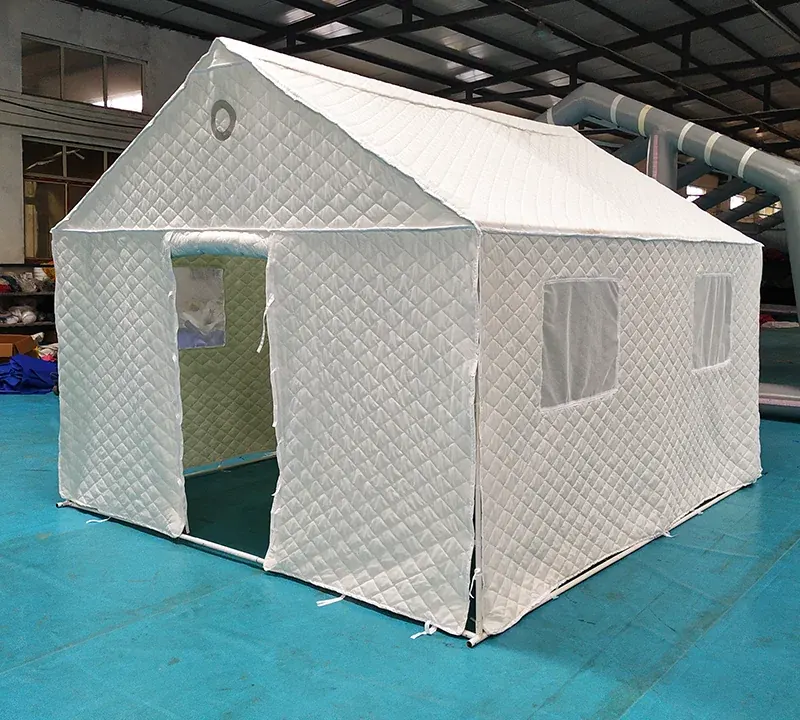
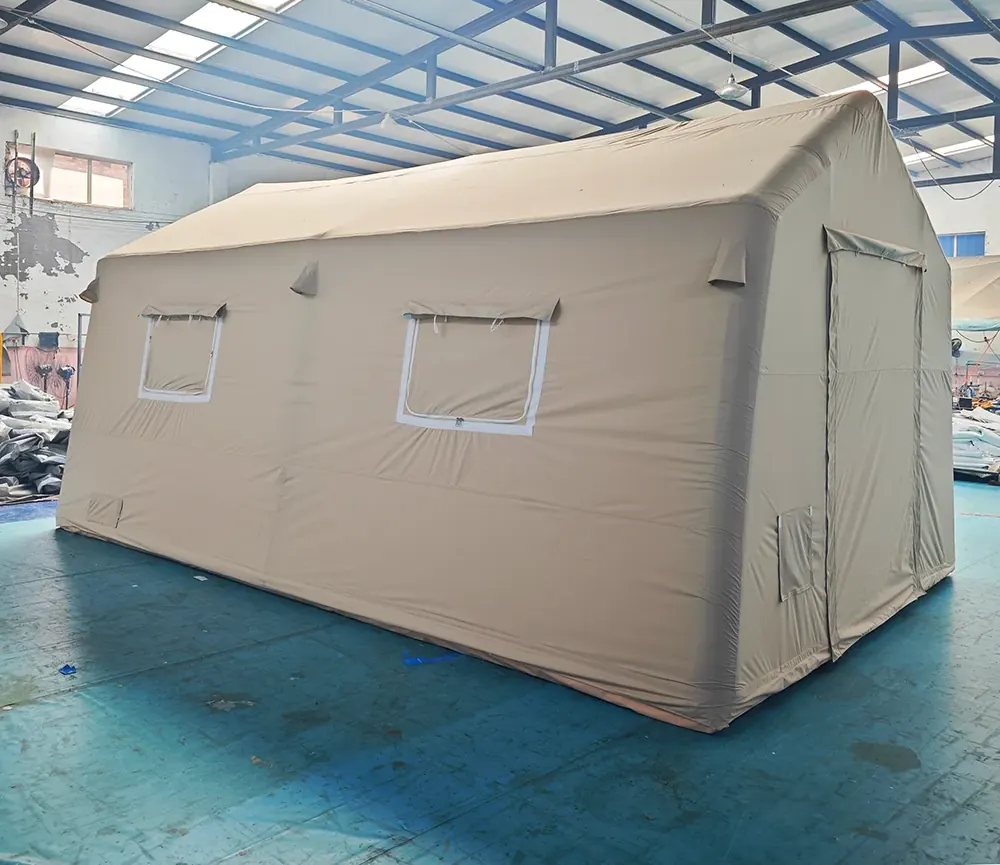
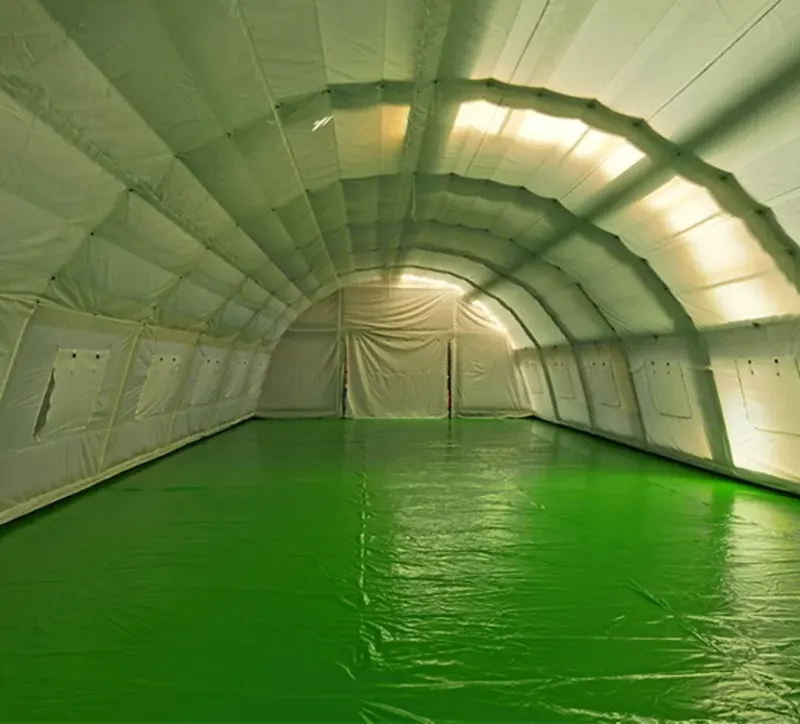
Shelter exteriors and interiors from the workshop
Real photographs of white inflatable shelters, a quilted insulated variant and a long-span interior.
FAQ
How long does an inflatable medical tent take to set up?
It depends on size, beam type, pump and crew. Ask the supplier for a setup time measured with the supplied pump and a stated crew size.
Can inflatable medical tents be connected into a field hospital?
Yes, if the modules are designed with matching connection points or corridors. Specify the layout before production.
Do inflatable medical tents need continuous power?
Low-pressure designs use a blower to maintain pressure; sealed high-pressure beams are inflated once and topped up. Choose based on your power availability.
Can you customise size, colour and branding?
ASEN builds to OEM/ODM briefs, including dimensions, interfaces, colours and agency markings.
Get a technical proposal
Send us your medical role, occupancy, site conditions and quantity. Our engineering team will reply with a proposed layout, supplied set and documentation scope.
- Request a technical proposal
- Email: sales@asenoutdoor.com
- WhatsApp: +1 650 788 6068
Questions before a medical shelter quotation
Tie the quotation to the clinical role and the equipment that must fit on day one.
- Which beam type, pump, crew size and repair kit belong to the model being quoted?
- Where do HVAC, power, partitions and module connections need to land for this layout?
Send the medical role, occupancy, site conditions and quantity for a layout and documentation proposal.
Information to attach to the RFQ
- Buyer company, destination and intended sales or operating channel
- Application, dimensions, quantity and required delivery date
- Reference photos, drawings, tender schedules or target products
- Required standards, labelling, packaging and inspection method